
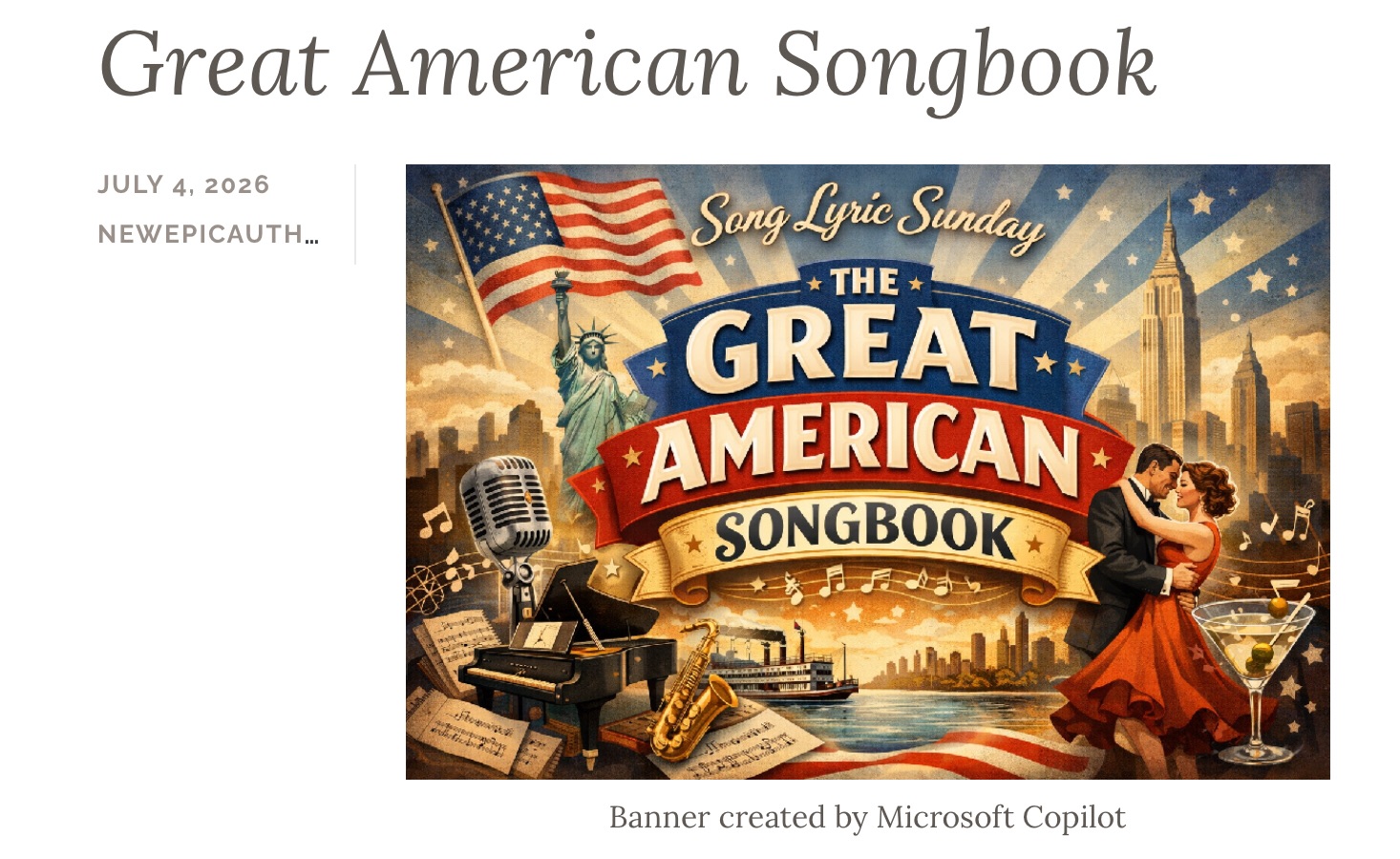
Nancy had the idea for this theme months ago, and I suggested that we save it for the Fourth of July weekend where America will be celebrating its 250th birthday. America has a rich tradition of creating music including classical, folk, popular, jazz, and rock, and the Great American Songbook primarily contains songs from the 1920s to the 1960s. The Great American Songbook consists of enduring standards, songs that have been played and sung over and over by multiple generations.
My first thought today was my favorite, Irving Berlin. “Israel Isidore Beilin Born May 11, 1888, Tyumen, Russia. DiedSeptember 22, 1989 (aged 101)
- Popular songs: ragtime, Broadway musicals, show tunes
Years active1907–1971Military career United States Army Service years1918–1919
Born in Russia, Berlin arrived in the United States at the age of five. His family left Russia to escape pogroms against the Jewish village of Tolochin.He published his first song, “Marie from Sunny Italy”, in 1907, receiving 33 cents for the publishing rights, and became known as the composer of numerous international hits, starting with 1911’s “Alexander’s Ragtime Band“. He also was an owner of the Music Box Theatre on Broadway. For much of his career, Berlin could not read sheet music, and was such a limited piano player that he could only play in the key of F-sharp; he used his custom piano equipped with a transposing lever when he needed to play in keys other than F-sharp. He was known for writing music and lyrics in the American vernacular: uncomplicated, simple and direct, with his stated aim being to “reach the heart of the average American”, whom he saw as the “real soul of the country”.

He wrote hundreds of songs, many becoming major hits, which made him famous before he turned thirty. During his 60-year career he wrote an estimated 1,500 songs, including the scores for 20 original Broadway shows and 15 original Hollywood films, with his songs nominated eight times for Academy Awards.[1] Many songs became popular themes and anthems, including “God Bless America“, “Alexander’s Ragtime Band“, “Blue Skies“, “Easter Parade“, “Puttin’ on the Ritz“, “Cheek to Cheek“, “White Christmas“, “Happy Holiday“, “Anything You Can Do (I Can Do Better)“, and “There’s No Business Like Show Business“. His Broadway musical This Is the Army (1942) was adapted into the 1943 film of the same name”. Wikipedia
Original lyrics
“Putin’ on the Ritz”
Have you seen the well to do
Up on Lenox Avenue
On that famous thoroughfare
With their noses in the air?
High hats and colored collars,
White spats and fifteen dollars
Spending every dime
For a wonderful time
If you’re blue, and you don’t know where to go to
Why don’t you go where Harlem flits?
Puttin’ on the Ritz
Spangled gowns upon the bevy of high browns
From down the levee, all misfits
Puttin’ on the Ritz
That’s where each and every Lulu-Belle goes
Every Thursday evening with her swell beaus
Rubbin’ elbows
Come with me and we’ll attend their jubilee
And see them spend their last two bits
Puttin’ on the Ritz
If you’re blue, and you don’t know where to go to
Why don’t you go where Harlem flits?
Puttin’ on the Ritz
Spangled gowns upon the bevy of high browns
From down the levee, all misfits
Puttin’ on the Ritz
***
Great American Songbook


Good choice Cheryl!
LikeLiked by 1 person
Great song choice!
LikeLiked by 1 person